
What leaves your device.
What RouteFrame keeps.
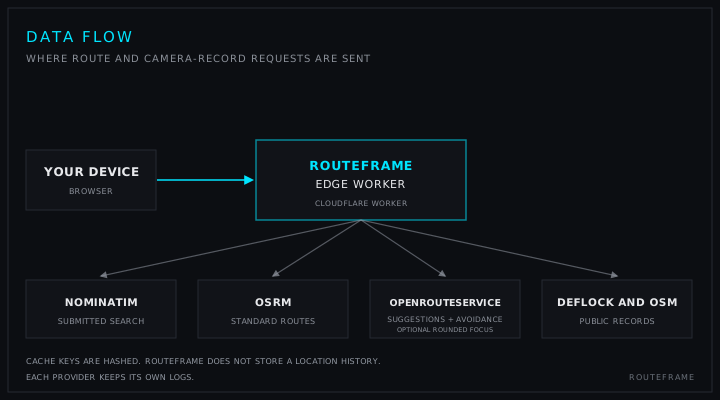
RouteFrame is designed to minimize collection, but route search still depends on outside mapping providers. This page states those transfers plainly.
Place searches
After you enter at least four characters and pause briefly, the partial place text is sent to the RouteFrame Cloudflare Worker and then to OpenRouteService for United States search suggestions. Destination suggestions also include the selected origin rounded to three decimal places, roughly neighborhood precision, so nearby matches rank first. If My Location is the selected origin, this approximate focus can be sent before you build the route. Requests are delayed, canceled when the text changes, rate-limited, and cached by a hashed query and rounded-focus key. RouteFrame does not send every keystroke or save typed prefixes to an application database. If you continue without choosing a suggestion, the complete submitted place text is sent through the Worker to OpenStreetMap Nominatim. OpenRouteService and Nominatim control their own server logs and retention practices.
National map and My Location
National public camera records load without requesting browser location. RouteFrame requests device coordinates only after you press My Location. The coordinates remain in current page state. A rounded version can focus destination suggestions, and the selected coordinates pass to the routing provider after you build a route. RouteFrame does not save them to a location-history database.
Driving routes
After you choose a place match, the selected start and destination coordinates are sent through the RouteFrame Worker to the public Project OSRM routing service for a standard route. Project OSRM controls its own server logs and retention practices.
Camera-avoidance routing
If you press Avoid Documented Cameras, RouteFrame sends the selected start and destination coordinates, plus nearby loaded public ALPR points for that corridor, to OpenRouteService (served through api.heigit.org and operated by HeiGIT gGmbH). OpenRouteService controls its own server logs and retention practices. This is a lower-exposure preference based on incomplete public records, not a guaranteed camera-free route.
Public surveillance records
RouteFrame preloads compressed national ALPR, video-camera, and audio-sensor source snapshots. A selected route triggers a current geographic-corridor refresh from DeFlock's regional cache and OpenStreetMap Overpass service. The corridor request uses coordinates, not the original address text. The optional county layer is a same-origin, precomputed point-in-polygon aggregate of the public DeFlock snapshot and Census county boundaries. ALPR, video-camera, audio-sensor, county aggregate, and attribution records can be incomplete, stale, or incorrect.
Selected camera context
Opening a camera record asks RouteFrame to send that public source point to OpenStreetMap Nominatim for an approximate road, locality, county, and state label. This is a camera record location, not your current location or an address you entered. The result is map context, not proof of ownership or responsible jurisdiction. The embedded OpenStreetMap view loads only after you choose Street Context. Google receives the public source point only if you open the optional Google Street View link.
Cloudflare edge processing
The application runs on Cloudflare Workers. Requests can appear in operational security and service logs controlled by Cloudflare. RouteFrame hashes place-query cache keys and does not intentionally write raw addresses to an application database or build a location-history profile.
Advertising
RouteFrame loads Google AdSense code on every page. Because that script runs in your browser, Google automatically receives your IP address, the address of the page you are on, the referring page, and can set and read its own cookies, whether or not an ad is shown. Google and its advertising partners may then process network, browser, device, page, cookie, local-storage, consent, and ad-interaction information to select, deliver, secure, and measure advertising under their own policies. RouteFrame keeps your route origin, destination, and coordinates out of the page address and does not pass them to AdSense as advertising parameters, but anything already present in the page address is visible to the script. Fonts are served from RouteFrame's own domain, so loading a page does not send your address to a font provider. Review Google's partner-site data explanation and Google My Ad Center for additional information and controls.
Map and navigation handoff
Map tiles are requested from OpenFreeMap. If you choose Google Maps, Apple Maps, or Share Route, the selected coordinates, place text, and route-shaping points needed for that action are handed to the service or your device share sheet. Their privacy practices apply after the handoff. RouteFrame does not claim that the route is anonymous.
Browser and sharing history
RouteFrame does not save a route to an application database. A navigation link you open, copy, or share can remain in browser history, synced browser data, screenshots, clipboard history, referrer logs, or provider logs outside RouteFrame's control. Clear those records on your device if you do not want to retain them.
Retention and deletion
RouteFrame has no user account system and no saved-route database in this release. Edge caches expire automatically. RouteFrame cannot delete provider-controlled logs or advertising data held by Nominatim, OSRM, DeFlock, OpenFreeMap, Google, Apple, Cloudflare, or other third-party providers.
Product identity
RouteFrame is presented as an independent public-data application. The public interface does not identify or link to an individual, consulting company, personal phone number, or personal email address.